The Fellowship
Dominic Steel
40 chapters4.626.8K reads
I got in by accident. He's assigned to make me quit. I won't.
The Alderton dining hall looked like something from a period drama. Vaulted ceilings. Stained glass throwing colored light across long oak tables. Portraits of dead men in gilded frames, oil-paint stares tracking the room like security cameras.
I didn't belong here.
The thought arrived uninvited, the way it always did in spaces like this. Spaces built for other people. People with buildings named after them. Great-grandfathers in those gilded frames.
My great-grandfather drove a truck.
"The orientation dinner will commence shortly," said a woman at the door, her voice carrying the particular crispness of old money. "Aurelius Fellowship initiates, please find your assigned seats."
Assigned seats. Of course. Even dinner was structured, controlled, predetermined. I scanned the room for my name, printed on a card in elegant calligraphy. Row after row of initiates were already settling in, young men and women who wore their privilege like second skin. Designer blazers. Family signet rings. The casual confidence of people who'd never been told no.
I found my card near the center of a table. Victoria Wells to my left. Graham Chen to my right. Names that sounded like they came with trusts attached.
Except me.
Emery Wright. First-generation college student. Scholarship recipient. The girl who'd gotten her acceptance letter three months ago and still wasn't sure if it was real.
"You're in my seat."
The voice came from behind me, cut crystal and cold. I turned to find a tall blonde woman with perfect posture and a smile that didn't reach her eyes.
"The card says Emery Wright." I tapped it with one finger. "That's me."
"Right." Her gaze swept over my blazer, secondhand, expertly tailored to hide its origins, and dismissed me entirely. "You're the clerical error."
The silence after felt deliberate. I kept my face neutral, a skill perfected through years of existing in spaces that didn't want me.
"Excuse me?"
"The scholarship mistake. Everyone's been talking about it." She slid into the seat beside mine. Victoria Wells. Of course. "The fellowship doesn't accept scholarship students. Never has. Someone in admissions made an error, and now they can't legally rescind without facing discrimination lawsuits." Another smile, sharp as glass. "So here you are. Congratulations on being an administrative headache."
I should have been devastated. Should have felt the weight of every eye that wasn't looking at me but somehow knew. Instead, a cold clarity settled behind my ribs.
They didn't want me here.
Good.
"Thank you," I said, my voice matching her sweetness. "It's nice to know I'm already memorable."
Victoria's expression flickered, surprise she smothered in half a second. Before she could respond, the chair on my other side scraped back.
"Move down, Wells. I'm sitting here."
The voice was low, smooth, weighted with the kind of authority that expected immediate obedience. I looked up.
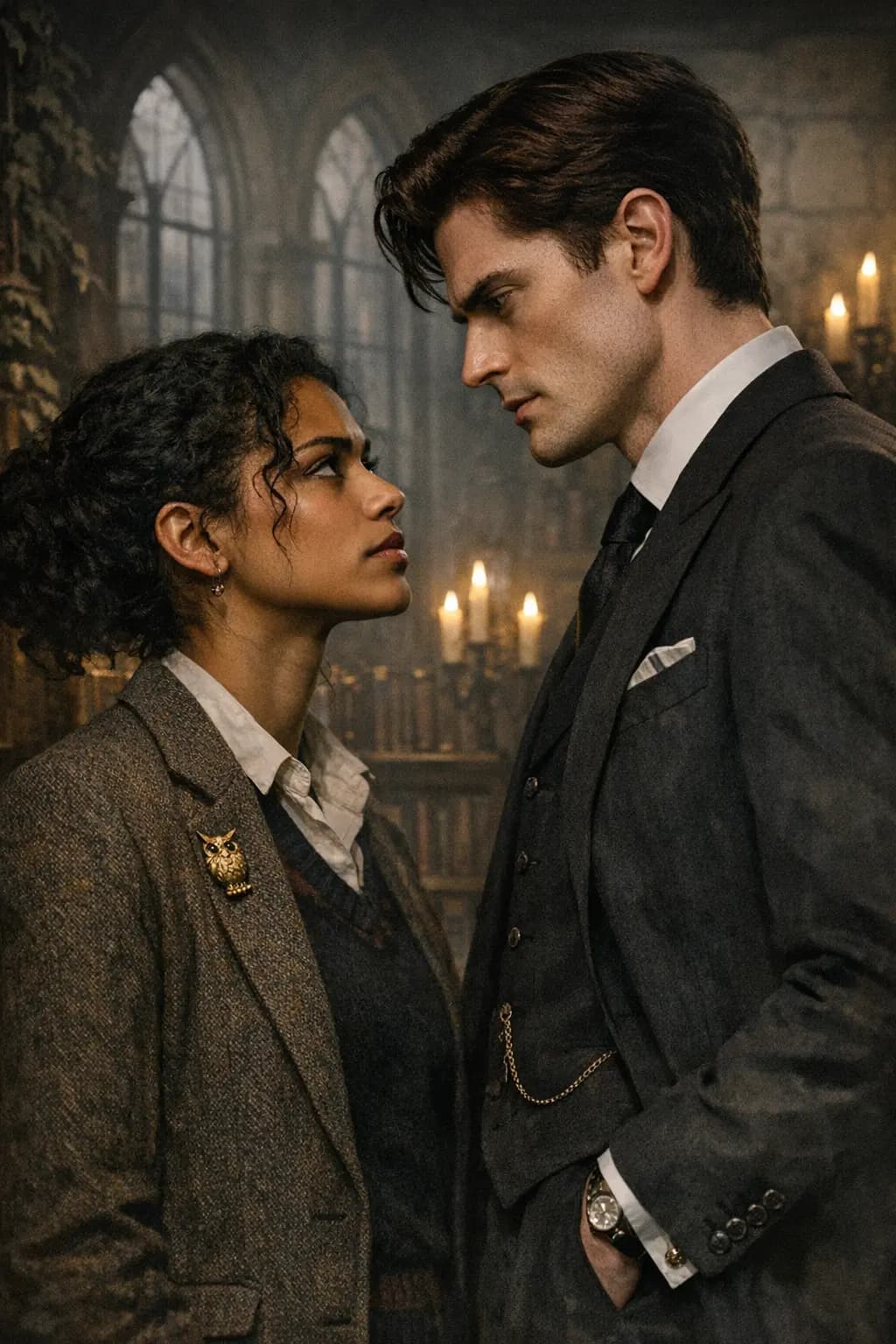
He was tall. Dark auburn hair, perfectly styled. Gray-green eyes. Cold appraisal. The kind of look that filed you under threat or irrelevant. Expensive suit, not the kind you bought off the rack, but the kind that was made for you specifically, with your family crest probably stitched into the lining.
Victoria moved without protest, grabbing her place card and sliding one seat over. Whoever he was, his name apparently trumped assigned seating.
He sat. Extended one hand across my peripheral vision to shake someone's across the table. Laughed at something I didn't hear. Then, finally, turned to me with the full force of those calculating eyes.
"You're the clerical error."
The same words. Different delivery. Victoria had been dismissive, petty. He made it sound like a scientific classification, a species designation.
"And you're the legacy who couldn't get in on merit." The response left my mouth before I could stop it. "We should form a support group."
Silence.
His hand, which had been reaching for his water glass, stopped mid-motion. Those gray-green eyes sharpened, and His jaw went still. Then his mouth curved, barely, like I'd said something in a language he hadn't expected me to speak.
"Beckett Alderton-Hale," he said finally.
Alderton. As in the university. As in the library, the scholarship fund, the half-dozen buildings with that name carved into stone. His family didn't just attend this school. They owned it.
"Emery Wright," I returned evenly. "As in the clerical error."
"You're going to want to watch that tongue." He picked up his water, took a measured sip. "The fellowship has traditions. Certain expectations. People who don't meet them tend to... transfer."
"Transfer?"
"Leave." The word landed like a verdict. "Usually by winter break. Sometimes sooner. The fellowship has a way of clarifying whether someone truly belongs."
I thought about what Victoria had said. What he was implying. The threats wrapped in polite language, the warning disguised as helpful advice.
"I don't transfer," I said. "I'm not very good at leaving."
"Everyone's good at leaving when the situation becomes untenable."
"And who decides what's untenable?"
For the first time, a real smile cut across his face. Brief. Lethal. The kind of smile that made you understand why people followed him.
"I do."
The dinner began. Courses arrived, each more elaborate than the last. Around me, conversation flowed, Latin phrases dropped casually, inside jokes about professors I'd never met, references to summer homes and family foundations. I ate in silence, listening, learning, cataloging.
Beckett Alderton-Hale ignored me for the rest of the meal.
But I caught him watching twice. Both times, he looked away too quickly.
After dinner, the fellowship's faculty advisor, a silver-haired professor named Thornton, gave a speech about tradition and excellence and the burden of privilege. I sat in the back and mentally translated: You are inheriting power. Don't embarrass us with it.
"Initiation begins tomorrow," Thornton concluded. "Report to the Aurelius Library, restricted section, at precisely seven pm. Tardiness will not be tolerated. Weakness will not be accommodated. You have been chosen..." his attention snagged on me, held "to join something greater than yourselves. Prove you're worthy of it."
The room applauded. I didn't.
Outside, the September air was crisp with approaching autumn. Leaves were beginning to turn on the old oaks that lined the quad, gold and crimson against the darkening sky. Gothic spires rose in silhouette, and the whole campus looked like something from a Gothic novel, the kind of place that dared you to feel comfortable.
"Wright."
I turned. Beckett was leaning against a stone pillar, hands in his pockets, looking like he'd stepped out of a trust fund advertisement.
"Alderton-Hale." I mirrored his casual stance. "Following me already? I'm flattered."
"A word of advice." He pushed off the pillar, approached. Up close, I could smell his cologne, something with sandalwood that smelled like it came in a bottle with no price tag. "What you said in there. About legacy. About merit. That kind of attitude won't serve you well."
"Noted."
"You don't even know what I'm offering."
"You're offering a warning. Probably several." I looked at him without flinching. "Keep your head down. Know your place. Don't make waves. How am I doing?"
His expression didn't change, but his attention sharpened. That interest again, becoming something more focused.
"You're going to regret talking to me this way."
"Maybe." I started walking toward my dorm, throwing the words over my shoulder. "But I doubt I'll be bored."
I didn't look back. Didn't have to.
His attention followed me like a hand on my spine. I felt it until the corner swallowed me.
My scholarship housing was in Hartwell Hall, the oldest dormitory on campus, which sounded prestigious until you realized it meant ancient plumbing, radiators that clanged at midnight, and rooms smaller than closets in the legacy housing. The four other scholarship students lived here too, scattered across the building's six floors.
I dropped onto my narrow bed and stared at the ceiling. Water stains made patterns in the plaster. Someone had carved initials into the wooden bedframe, decades old.
Clerical error.
The words should have stung. Maybe they would, later, in the dark hours when pride gave way to honesty. But right now, all I felt was determination.
They hadn't wanted to let me in. Their perfect, centuries-old system had cracked just enough for someone like me to slip through, and now they couldn't get rid of me without lawsuits.
So they'd try to make me leave.
I thought about Beckett's warning. People who don't meet them tend to transfer. Usually by winter break.
How many scholarship students had stood where I was standing? Had felt what I was feeling? How many had faced the trials and warnings and casual cruelties, and decided it wasn't worth it?
I didn't know. But I intended to find out.
My laptop was old, held together with duct tape and optimism. I opened it anyway, logged into the university archives, and started searching.
Aurelius Fellowship. Founding members. Initiation traditions.
The official histories were sanitized, phrases like "rigorous academic standards" and "selective membership criteria." Photos of well-dressed young men (and, eventually, women) posing in the Aurelius Library, clutching leather-bound books and looking appropriately serious.
But there were gaps. Names that appeared once and never again. Faces in one year's photo missing from the next. The phrase "transferred for personal reasons" repeated with suspicious frequency.
I made a list. Kept digging.
Somewhere around midnight, I found it, a twenty-year-old campus newspaper article, buried in the digital archives. The headline read: SCHOLARSHIP STUDENT WITHDRAWS FROM AURELIUS FELLOWSHIP, CITING "HOSTILE ENVIRONMENT."
The article was short, clearly edited. No names given. But there was a quote from the university administration: We take all concerns seriously and will conduct a thorough review.
Nothing more.
I searched for follow-up articles. There were none.
Clerical error, Victoria had called me. Like I was a glitch in their system, a mistake to be corrected.
But glitches had power. Glitches exposed weaknesses. Glitches, if they were persistent enough, could crash entire systems.
I closed my laptop and smiled in the dark.
They wanted me to transfer by winter break.
I wanted to know what happened to everyone who came before me.
One of us was going to be disappointed.
Dominic Steel
I got in by accident. He's assigned to make me quit. I won't.